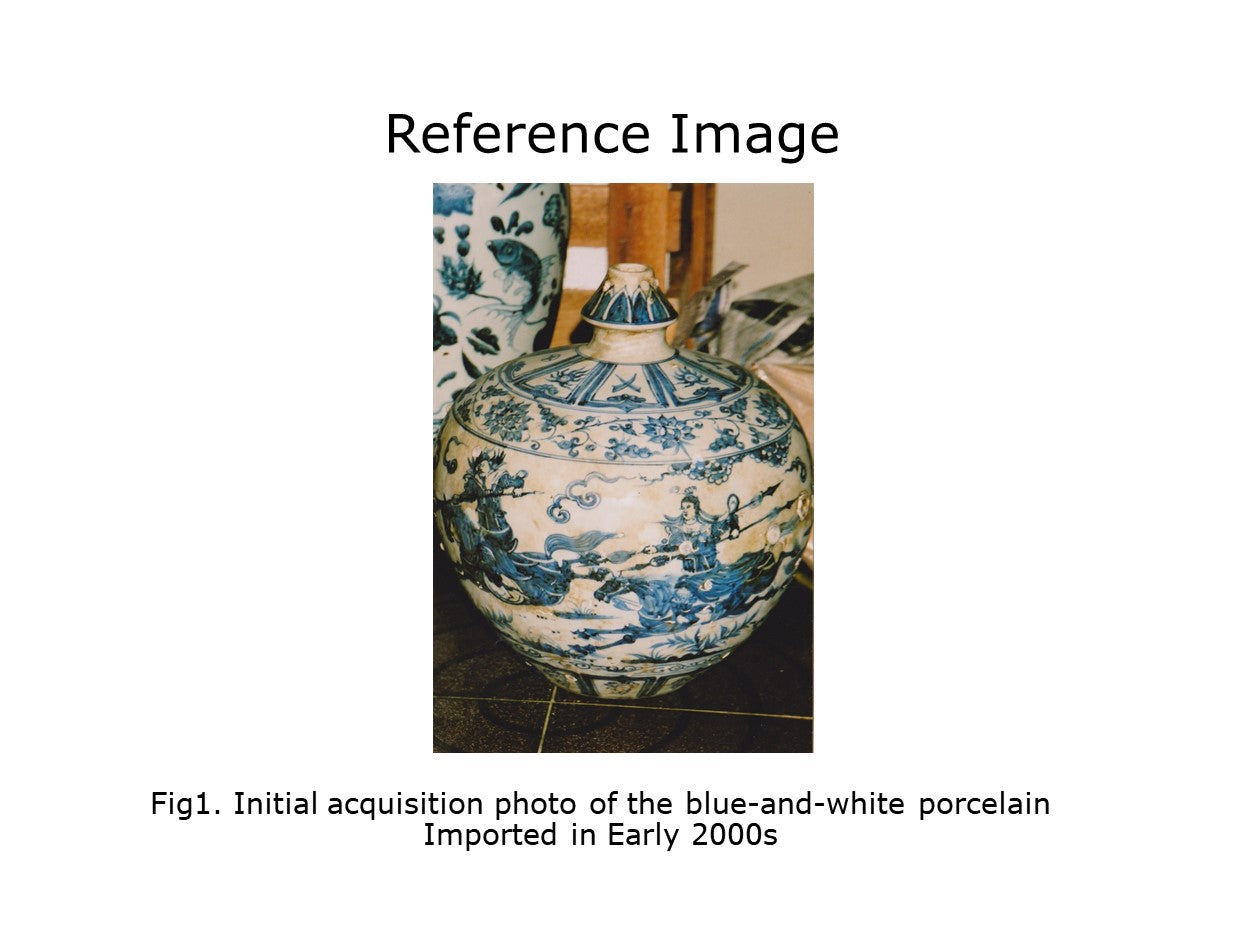
A large globular jar with a short cylindrical neck and faceted pointed mouth, decorated in underglaze blue with a principal register of armored warriors in mounted combat. The figures — generals with articulated armor, windswept manes, and weapons raised — are rendered with the assured, energetic brushwork that distinguishes the finest minyao(for export purpose) figure painting of the Transitional period to Early Qing Dynasty, free from the formal constraints of imperial workshop production. The iconography is consistent with narrative scenes from the Romance of the Three Kingdoms or Water Margin. The decorative scheme follows the layered register convention of Yuan–Ming storage jars: petal panels at the mouth, radiating shoulder bands, a floral scroll frieze above the figural zone, and geometric panels at the lower body. The cobalt ranges from deep saturated washes to fluid lighter passages. The base is unglazed with a dense white body; no reign mark is present.
Acquisition photographs (early 2000s) document a heavy marine deposit across the vessel surface, subsequently removed through repeated conservation treatment.
Period : Qing Dynasty(Presumably Kangxi or Yongzheng Period)
Type : Jar
Medium : Blue and White glaze
Dimension : 33cm(Height) x 7cm(Mouth Diameter)
Condition : Excellent(Although it was soaked in hot water to remove the salt at the time of acquisition, slight salt residue remains on the surface. )
Provenance: Southeast Asia, South China Sea from Shipwreck in early 2000s
Reference :
1) Christies Hong Kong 26 SEP 2024 - Lot 2
(Price realised : 819,000 HKD / Type : related)
https://www.christies.com/en/lot/lot-6495108?ldp_breadcrumb=back
* Yuan–Ming Archaism in Qing Dynasty Ceramics
During the Qing dynasty, the deliberate revival of Yuan and Ming ceramic traditions represented far more than imitative craft — it was a sophisticated artistic and cultural project. Qing imperial kilns, particularly those at Jingdezhen, systematically studied and reproduced the formal vocabulary of earlier dynasties: the powerful cobalt blues of Yuan qinghua, the restrained elegance of Xuande wares, and the decorative exuberance of Wanli polychromes. This archaizing impulse, known as fanggu (仿古), was pursued with both technical mastery and creative ambition.
Such wares served multiple functions. Domestically, they satisfied an educated literati taste for antiquity and signaled cultural legitimacy through continuity with the dynastic past. For the export market, they met sustained overseas demand for Chinese antiquities, offering works of comparable aesthetic quality to earlier prototypes while reflecting the refined sensibilities of their own era.
Far from passive reproduction, Qing ceramicists reinterpreted inherited forms through the lens of contemporary technique — achieving greater precision in potting, consistency in glaze, and refinement in painted execution. The result was a body of work that honored its sources while constituting a distinct artistic achievement in its own right. This dialectic between tradition and innovation lies at the heart of Qing ceramic production, and accounts in no small part for its enduring prominence in both scholarly study and the international collecting market.