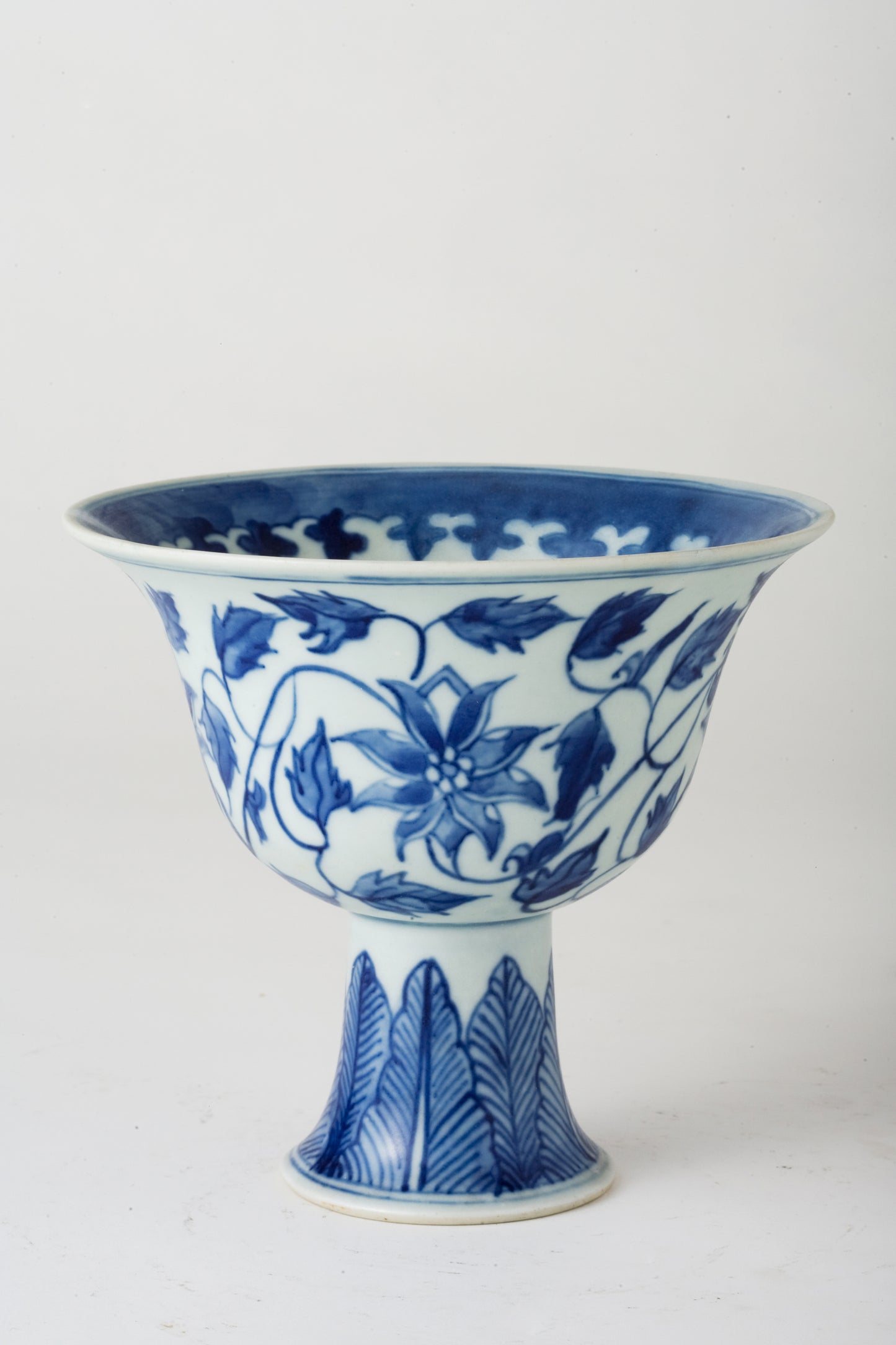
Blue and White Stem Cup, Qing Dynasty with Xuande Mark Bearing Six-Character Reign Mark
Blue and White Stem Cup, Qing Dynasty with Xuande Mark Bearing Six-Character Reign Mark
Couldn't load pickup availability
A finely potted stem cup of classical gaozu bei form, painted in underglaze blue with scrolling lotus on the exterior bowl, a band of reserved cloud-head motifs against a blue ground at the interior rim, and a central floral medallion to the base of the bowl.
The base bears a six-character reign mark Da Ming Xuande Nian Zhi in two columns of regular script. The script is neat and evenly spaced, consistent with the archaizing reign marks characteristic of early Qing production at Jingdezhen. Compared to the dynamic, rhythmically charged brushwork of genuine Xuande marks, the calligraphy here shows a degree of studied refinement that points to Kangxi–Yongzheng manufacture.
The cobalt blue is applied with natural tonal variation and a painterly quality consistent with early Qing style. The iron-flecked heaping and piling effect intrinsic to genuine Xuande wares fired with imported Sumatran cobalt is absent — a key distinction that firmly situates this piece within the fanggu tradition rather than original Ming production.
The surface retains slight saline residue consistent with seabed recovery, treated at acquisition by hot water immersion.
Period : Qing Dynasty(Presumably Kangxi or Yongzheng Period)
Type : Stembowl
Medium : Blue and White glaze
Dimension : 14 cm(Height) x 13cm(Diameter)
Condition : Excellent(slight salt residue remains on the surface, and te glaze is worn primarily around the edges, such as the handles and rim.)
Provenance: Southeast Asia, South China Sea in early 2000s
Reference :
1) Sotheby's New York 23 March 2022 - Important Chinese Art - Lot 261
(Price realised : 50,400 USD / Type : related - Ming style)
https://www.sothebys.com/en/buy/auction/2022/important-chinese-art/a-ming-style-copper-red-decorated-three-fish
2) Christies Newyork 22 MAR 2018 - The Studio of the Clear Garden: Chinese Ceramics and Works of Art - Lot 604
(Price realised : USD 732,500 / Type : related - Ming style)
https://www.christies.com/en/lot/lot-6129537
3) Sotheby's London 4 November 2020 - Imperial Porcelain – A Private Collection - Lot 19
(Price realised : GBP 75,600 / Type : related - Yuan style)
https://www.sothebys.com/en/buy/auction/2020/imperial-porcelain-a-private-collection/a-rare-yuan-style-doucai-meiping-qing-dynasty-18th
4) Asian Art Museum, San Francisco - Object number B60P88
(Type : related - Ming style)
https://searchcollection.asianart.org/objects/7408/vase-with-dragon
* Yuan–Ming Archaism in Qing Dynasty Ceramics
During the Qing dynasty, the deliberate revival of Yuan and Ming ceramic traditions represented far more than imitative craft — it was a sophisticated artistic and cultural project. Qing imperial kilns, particularly those at Jingdezhen, systematically studied and reproduced the formal vocabulary of earlier dynasties: the powerful cobalt blues of Yuan qinghua, the restrained elegance of Xuande wares, and the decorative exuberance of Wanli polychromes. This archaizing impulse, known as fanggu (仿古), was pursued with both technical mastery and creative ambition.
Such wares served multiple functions. Domestically, they satisfied an educated literati taste for antiquity and signaled cultural legitimacy through continuity with the dynastic past. For the export market, they met sustained overseas demand for Chinese antiquities, offering works of comparable aesthetic quality to earlier prototypes while reflecting the refined sensibilities of their own era.
Far from passive reproduction, Qing ceramicists reinterpreted inherited forms through the lens of contemporary technique — achieving greater precision in potting, consistency in glaze, and refinement in painted execution. The result was a body of work that honored its sources while constituting a distinct artistic achievement in its own right. This dialectic between tradition and innovation lies at the heart of Qing ceramic production, and accounts in no small part for its enduring prominence in both scholarly study and the international collecting market.