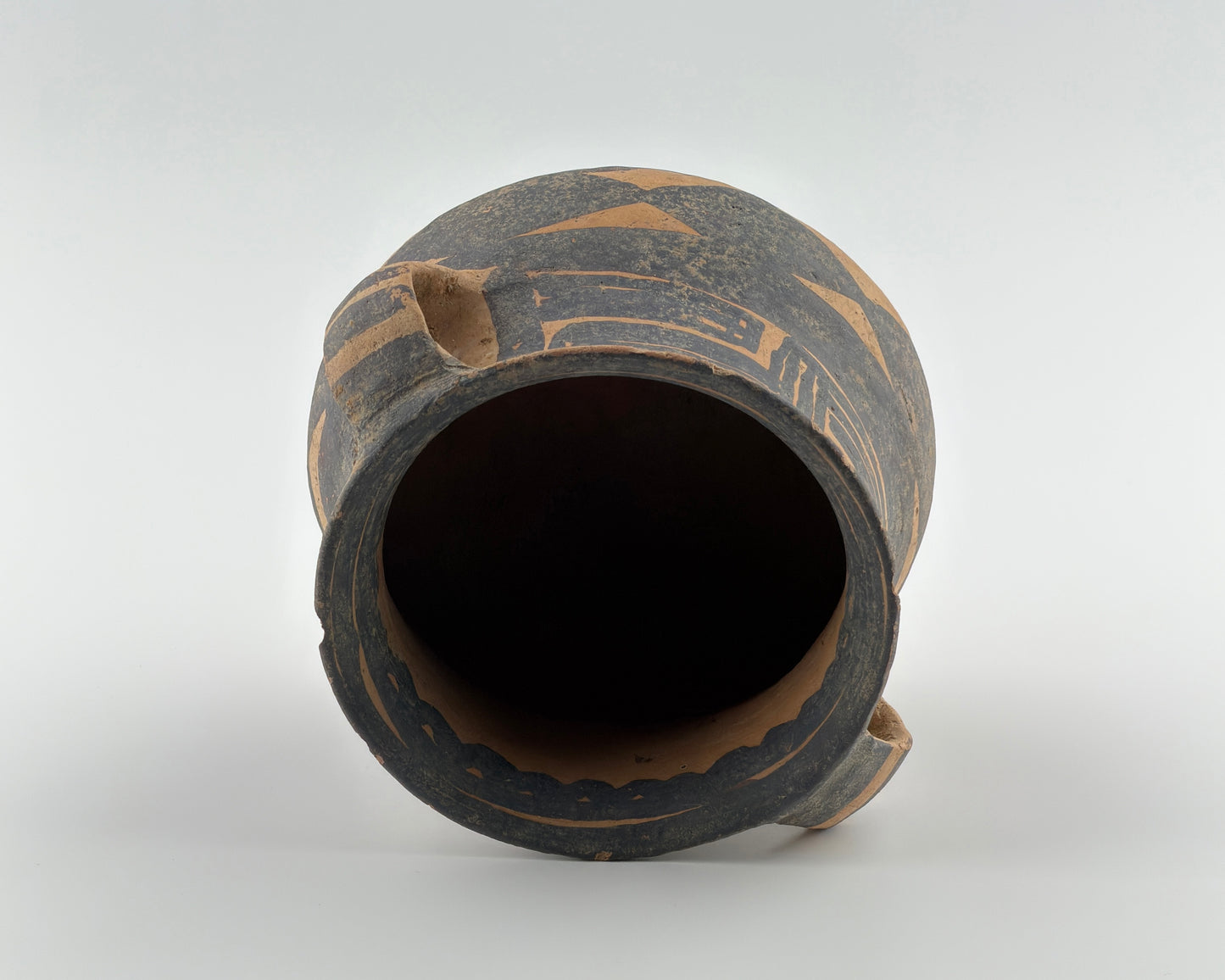
Neolithic Pottery Jar, Majiayao culture
Neolithic Pottery Jar, Majiayao culture
Couldn't load pickup availability
A fine example of Majiayao culture painted pottery. Buff earthenware body decorated in dark pigment with geometric lattice and diamond (X-pattern) motifs, encircling the shoulder in horizontal bands. Two loop handles at the neck, everted rim, and a rounded, swelling body tapering to a flat, unpainted base. Surface shows expected age-related wear and firing marks consistent with excavation.
Period: Neolithic period, Presumably from Majiayao culture (ca. 3300–2050 BCE)
Medium : Earthenware with pigment
Type : Jar
Size : 19cm (Height) x 15cm(Mouth Diameter)
Condition : Good(with wear and encrustation consistent with age and small chips on mouth part)
Provenance : Acquired in late 1990s from Hongkong
Reference : Christies Newyork 20–27 Mar 2018 - Lot 4 - TWO PAINTED POTTERY JARS
(Price realised : USD 16,250 / Type : Closely related)
https://onlineonly.christies.com/s/art-china-new-york-spring-edition/two-painted-pottery-jars-4/53632
* Neolithic pottery
Neolithic pottery from China, dating approximately between 10,000 BCE to 2,000 BCE, is a significant cultural artifact that reflects the rich culture and advanced technology of the region during this era. The pottery found across various regions of China displays unique styles and techniques, indicating a diverse and sophisticated cultural landscape.
During the Neolithic period, pottery in China was predominantly used for agricultural purposes, including storage containers, cooking vessels, and dining utensils. It was common for Neolithic Chinese cultures to decorate pottery with intricate patterns or colors, often reflecting the religious beliefs or life philosophies of the time. For instance, pottery from the Hemudu culture in the Yangtze River basin is known for its black and red patterns, while the Yangshao culture in the Yellow River basin is characterized by its fine linear designs.
The shapes and sizes of Neolithic Chinese pottery varied greatly, influenced by the climate, geography, and natural resources of each region. Some areas prioritized large and heavy storage containers, while others required smaller and more portable bowls for convenience.
Archaeological excavations of this pottery have been crucial in understanding the transition to settled life, the advancement of agricultural techniques, and the complexity of early societies in China. The production techniques and stylistic decorations of the pottery evolved over time, and these variations provide invaluable data for studying the development and cultural exchanges of ancient Chinese societies.