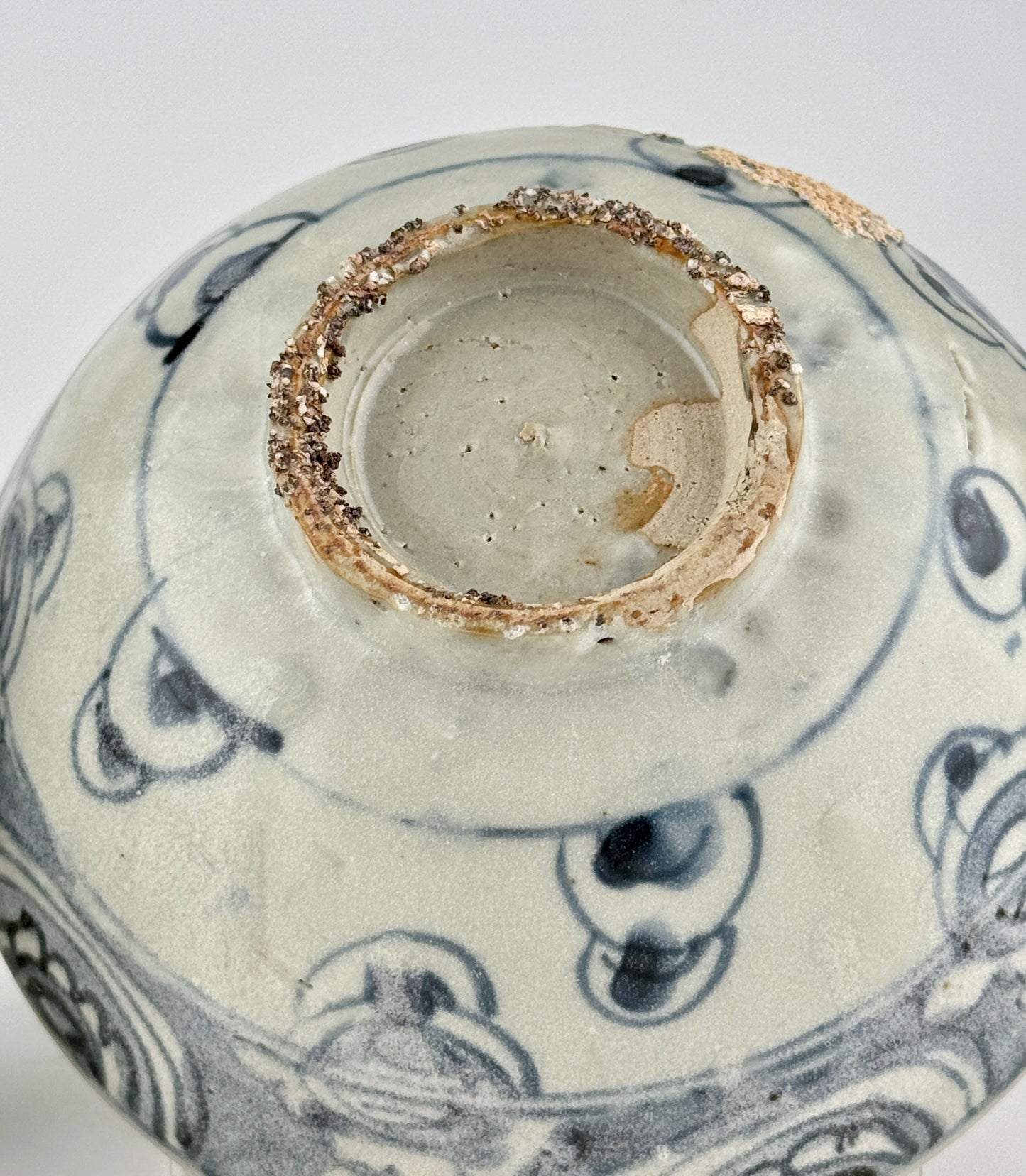
Pair of Bowls from Shipwreck, Late Ming Era(16-17th century)
Pair of Bowls from Shipwreck, Late Ming Era(16-17th century)
Couldn't load pickup availability
These shallow bowls feature stylized floral and wave motifs rendered in fluid cobalt brushwork beneath a clear glaze. The slightly everted rims and neatly cut foot rings are characteristic of export wares produced in southern kilns during the Ming period. Marine encrustations and glaze degradation attest to prolonged submersion in a maritime context, offering valuable insight into historical trade routes and overseas demand for Chinese ceramics.
Period: Late Ming Dynasty
Type: Bowl
Medium : Blue and White
Size : 9cm(Height), 19cm(Diameter)
Condition : Good(Marine encrustation is attached on one bowl)
Provenance : Presumably from the shipwrecked Binh Thuan Ship
Reference :
1) Asian Ceramic Found along Maritime Silk Route by The National Museum of Vietnamese History - p.136
2) Christie's Melbourne, 2004 - The Binh Thuan Shipwreck, auction sale catalogue
* Binh Thuan ship
The Binh Thuan shipwreck was discovered in 2001 near the province of Binh Thuan, Vietnam. It is the remains of a late 17th-century Chinese merchant ship that was carrying a variety of trade goods, predominantly Chinese blue and white porcelain, along the Southeast Asian trade routes.
At the time of discovery, the ship held a large quantity of ceramics, along with wooden, metal artifacts, and other trade items, most of which were well-preserved. The porcelain recovered from the Binh Thuan shipwreck demonstrates exquisite craftsmanship and provides insight into the production techniques and aesthetics of Chinese porcelain at the time, as well as the trade relationships between China and Southeast Asia.
This find has made significant contributions to the fields of maritime archaeology, history, and the study of trade routes. The artifacts from the Binh Thuan shipwreck are now displayed in various museums and by private collectors, serving as valuable resources for studying the art and culture of the late Ming Dynasty.