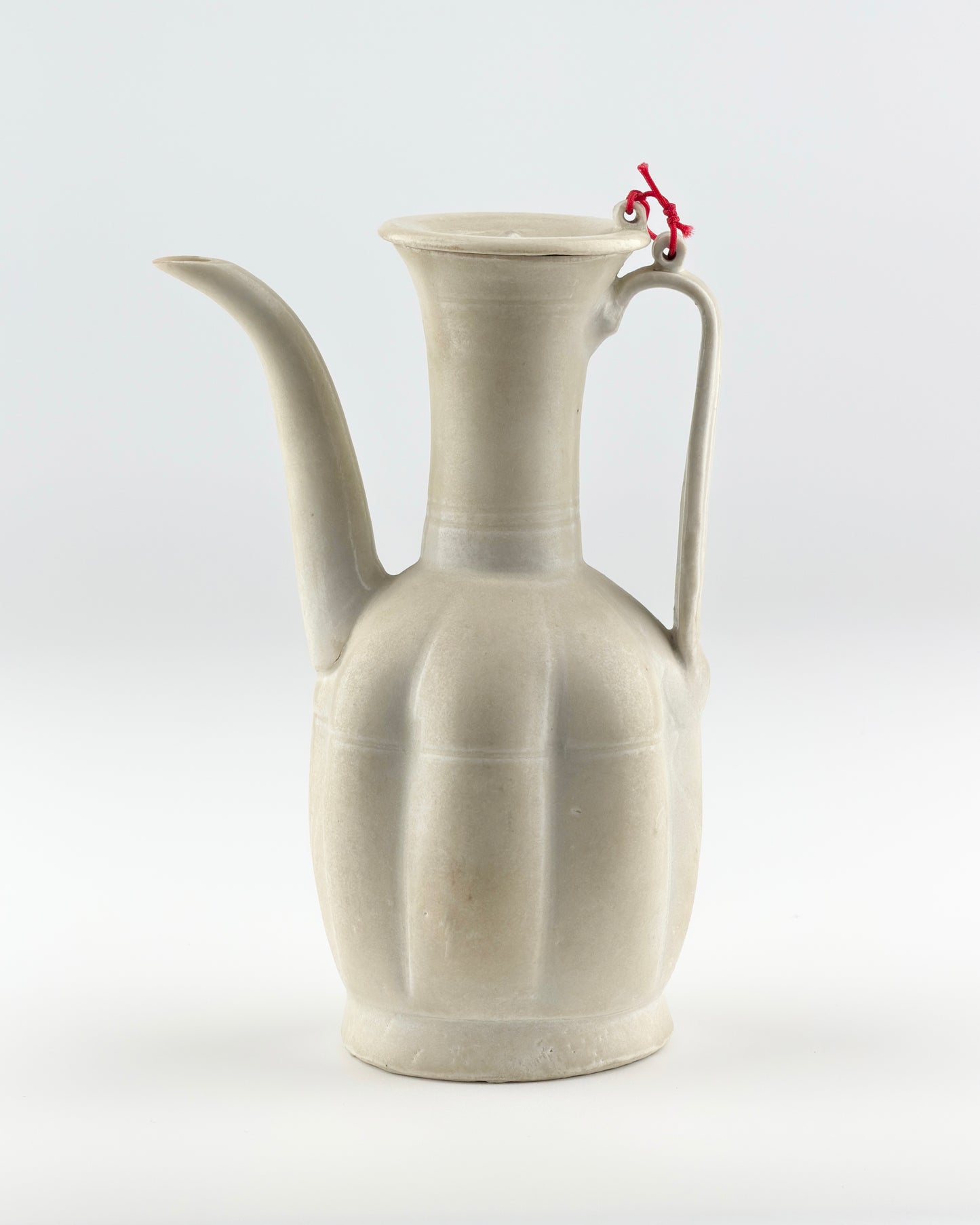
Rare Cream Glazed Ding Yao Ewer And Cover, Song Dynasty (960–1279)
Rare Cream Glazed Ding Yao Ewer And Cover, Song Dynasty (960–1279)
Couldn't load pickup availability
The body is articulated with clearly defined segmented ridges, creating a strong sense of structure. A tall, straight neck flares gently at the rim, balanced by a smoothly curved spout and a simple, angular handle. The surface is evenly covered with a pale whitish to ivory-toned transparent glaze, with a neatly finished low ring foot and an unglazed base.
Period : Song dynasty(960-1279)
Type : Creamy-white ding yao glaze Ewer
Provenance : Acquired in late 1990s from Hongkong
Height : 17.8cm
Condition : Excellent
Reference :
1) THE MET Accession Number: 18.57.1
(https://www.metmuseum.org/art/collection/search/49214)
2) Sotheby's London 2018 <St George Street Sale> Asian Art Lot 208
* Ding-Yao Ware
Ding ware, produced primarily in Dingzhou, Hebei province, flourished during the Northern Song dynasty (11th–12th century) and is among the finest examples of early white porcelain in China. It is characterized by its ivory-tinged white glaze, thin and compact clay body, and refined carved or molded decoration rendered beneath a translucent glaze.
The body of Ding ware is made from fine, nearly pure porcelain clay, usually of a warm, ivory-white tone rather than pure white. The glaze—highly transparent and slightly viscous—often pools faintly in the recesses, creating a soft creamy hue and emphasizing the carved motifs. This glaze was fired in a reduction atmosphere at high temperature, producing a smooth and glassy surface with a subtle satin sheen.
Decoration was typically achieved by incising or molding floral and foliate designs, such as lotus, peony, or scrolling vines. The carving is shallow yet precise, executed with smooth, confident strokes that appear softened beneath the glaze. Unlike the sharper outlines of later imitation wares, authentic Ding carving retains a fluid, almost hand-drawn quality.
A distinctive feature of Ding ware is its unglazed rim (露胎口). Because vessels were fired upside down to prevent the glaze from adhering to the kiln supports, the mouth rim was left bare and often fitted later with a metal band (usually silver or bronze). This firing method left a thin, unglazed edge that is a key diagnostic trait in authentication.
The footring is typically narrow and neatly trimmed, revealing the fine, dense, slightly buff-colored clay with traces of firing adhesions (spur marks). Over time, genuine Ding pieces may display mild surface iridescence or minute crazing due to glaze aging—considered positive evidence of long-term burial or environmental exposure.
In aesthetic terms, Ding ware exemplifies the Northern Song ideal of purity and restraint, combining delicate craftsmanship, subtle coloration, and quiet luminosity. From a connoisseur’s standpoint, its authenticity is judged by the soft translucence of the glaze, the precision yet warmth of the carving, and the natural oxidation and tactile aging of the exposed clay areas.